A robot launch has one hard constraint that software launches do not: the product has to be physically ready, on camera, in a place where it can actually run. Everything else, the announcement, the conference slot, the investor update, is already on a calendar. This is the plan we use in robotics video production to fit a launch film into that window, in the order the decisions usually need to be made.
Start With What Will Definitely Exist on Shoot Day
Every robotics launch has three versions of the product: the one in the pitch deck, the one the engineering team is still fixing, and the one that will exist on the day you booked the crew. Plan the film around the third one.
Write a single page before anything else: what the machine does, on what surface, at what speed, for how long before it needs a reset, and who is allowed to see it before the announcement. That page decides the shoot schedule, the shot list and whether part of the film has to be built in 3D instead of filmed. It also saves the most common launch-week disaster, which is discovering on set that the demonstration takes four minutes to reset.
Weeks 8 to 6: Define the Story and the Claim Set
Two questions get answered here, and they are separate.
The story: what the audience should understand ninety seconds after watching. Not the feature list. The reason the machine matters, in the words of the people who built it.
The claims: every factual statement the film will make, written down and signed off by whoever owns engineering. Reach, payload, speed, degrees of freedom, materials, uptime, the environments it is rated for. Robotics buyers check these against spec sheets, and one wrong number in a caption costs more trust than the film earns.
This is also when you decide the primary audience. A launch film for investors, a demonstration for procurement and a recruitment film can share footage but almost never share an edit. Our 9-point checklist for briefing a production company covers the rest of what belongs in the brief.
Weeks 6 to 4: Lock Locations, Access and Permissions
Where the machine actually lives determines everything about the shoot: lighting, power, noise, floor space for the camera, and how long you get before the facility needs the space back.
For a client site or a working facility, the list is short and boring: a named contact, a safety briefing, a certificate of insurance, agreed working hours, and a plan for what happens if production has to stop for operational reasons. Filming without stopping the operation is often possible, but it has to be planned rather than discovered.
If the hardware is under embargo, add the confidentiality terms now: who can be on set, who reviews footage, where files are stored, and when they are released.
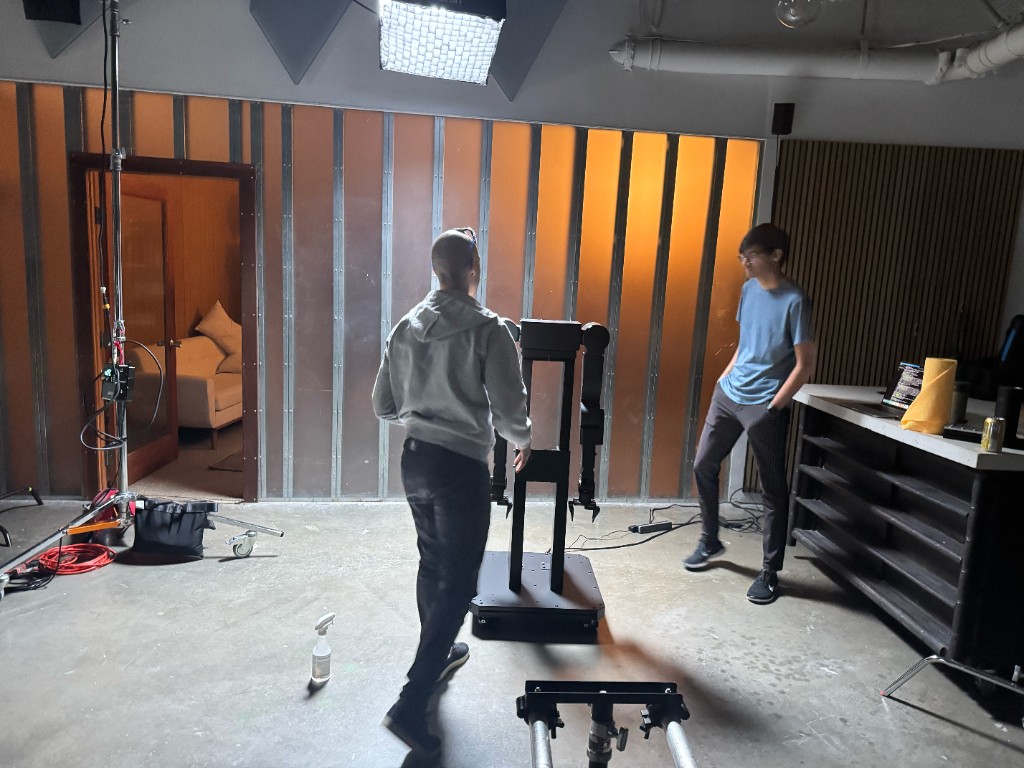 Setting up AlmondBot's robotic arm on the location we found and rented for the launch film, 2026.
Weeks 4 to 2: Shoot the Demonstration, Not the Montage
The shoot itself is where robotics films get better or worse, and it comes down to a few unglamorous decisions.
- Shoot the full task, unbroken, at least once. Cutaways are for the edit. An unbroken take is the evidence a technical buyer is looking for.
- Plan for resets, charging and recovery. A robot that needs two minutes between runs has to be scheduled like a cast member, not like a prop.
- Light for the machine, not just the shot. Dark and reflective hardware eats detail. Lighting that ignores the sensors can trigger behavior you did not ask for, so any change near the machine's field of view gets cleared with the engineering team first.
- Get the human in frame. An operator working alongside the robot answers the question every buyer and every nervous stakeholder is actually asking.
- Capture the parts you cannot reshoot. Macro detail, connector close-ups, chassis texture and the sound of the machine working. None of it is on the shot list from marketing, all of it makes the film feel real.
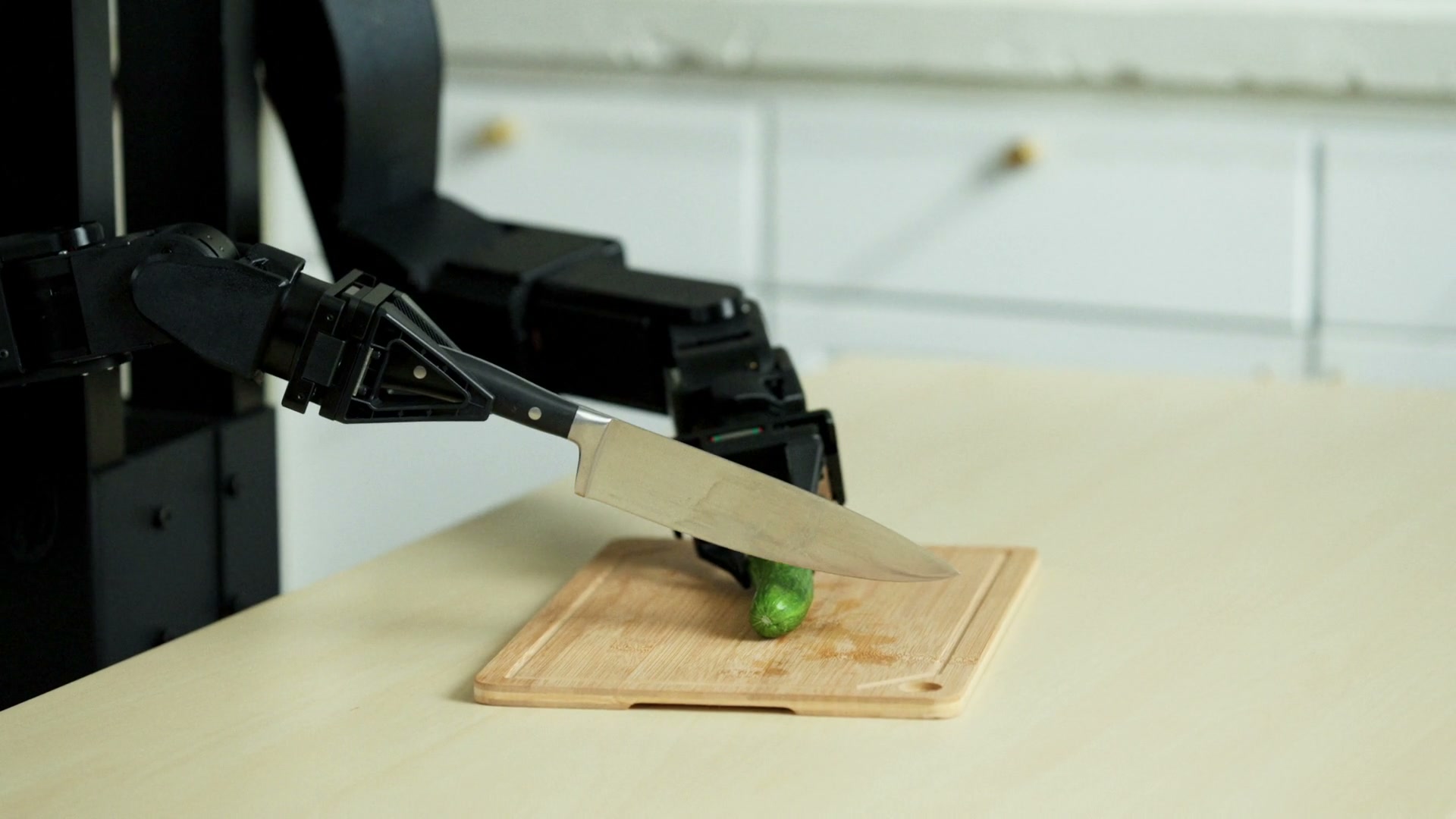 A dexterity demo from the AlmondBot robotic arm launch film, 2026.
If this is your first hardware shoot, the specific on-camera problems are worth reading separately: how to film a robot on camera covers resets, sensor-safe lighting, flicker and autonomy.
Weeks 2 to 0: The Deliverable Pack
The hero film is one asset out of ten. A launch that lands usually ships a kit:
- The hero film, 60 to 120 seconds.
- Vertical and square cuts for LinkedIn, Instagram and TikTok, cut for sound-off viewing.
- Three to five short clips for the announcement post and the investor deck.
- Stills pulled from the same shoot, for press and the website.
- A silent loop for the booth, and a version with captions for conference screens.
- B-roll and raw demonstration footage for the sales team, so a rough cut can answer a prospect without waiting for the next production.
Decide this list before the shoot, not after. Planning cutdowns in pre-production reduces rework, but additional deliverables are priced according to scope. Cutdowns requested after the edit is locked cost more than the same versions planned up front. We wrote the process up separately in how to repurpose one commercial into 12 social cuts, and six product launch video examples show what different launch packs look like.
Pre-Launch Hardware: The 3D Route
Sometimes the machine is not ready, or cannot be photographed at all. Exploded views, cutaways, motion paths and scale comparisons can all be modeled from the files engineering already has, and intercut with real footage of the prototype. The detail is in 3D animation from CAD.
Two rules keep this honest. Model from the current engineering files rather than from a marketing illustration, and label anything visualized as visualized. A 3D section that overpromises what the hardware will do is worse than no 3D section at all.
What the Launch Actually Has to Prove
Four things, in order of how often they get left out.
- The hardware, in detail. The mechanism, the sensors, the build. Buyers read craft as competence.
- The environment. The floor, the site, the conditions. A lab-only film answers a lab-only question.
- The task, complete. Not the highlights. The full action, and what it needs in order to happen.
- Proof from outside the building. A customer, an operator, a deployment. This is the part that shortens deals and almost never gets budget before the first launch.
Where Production Is Heading
Robots are turning up on the other side of the camera as well. WPP, Boston Dynamics and Canon have shown Atlas operating a cinema camera for shots that need to be repeated exactly, and NVIDIA's Cosmos models are being used to generate synthetic environments to train robots for sets and sites that are too expensive or too dangerous to rehearse in. None of that replaces a crew, but it changes what is possible when the shot has to be identical forty times in a row.
Robotics Video Production
We make launch films, technical demonstrations and 3D explainers for robotics companies, with pre-production through final color in-house and a first cut within one week of wrap. See the robotics video production service, or read how we built AlmondBot's robotic arm launch film. Budgets are explained on our pricing page.